It is a recommendation, never a requirement
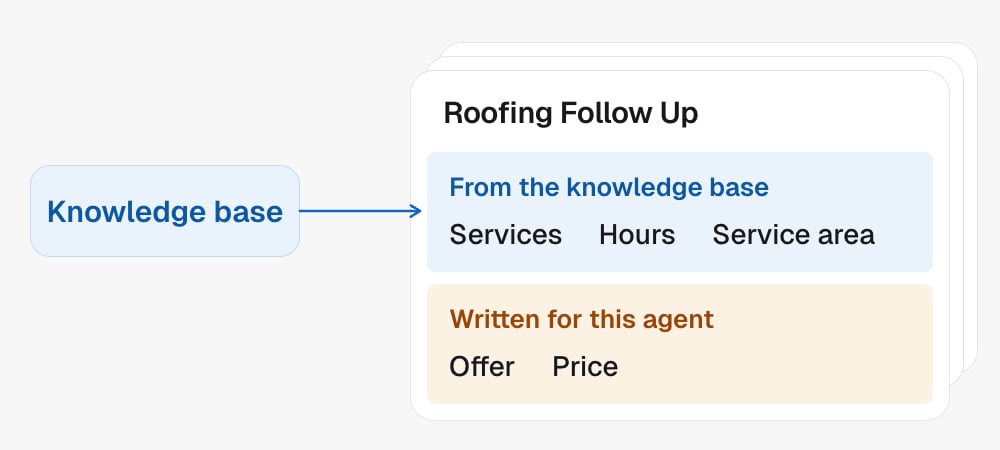
A project with no knowledge base works fine. Agents build, scripts write, campaigns run. Nothing is blocked. So treat it as something worth having when it helps, not a form to fill in first. The moments it earns its keep are obvious when they arrive: you are writing a first script and there are no business facts to work from, or you notice you have typed the same detail into three agents.What goes in
Durable facts, the ones that are still true next quarter and true for every campaign:- What the business actually does
- Services in scope, and services explicitly out of scope
- Location, service area, contact channels, website
- Opening hours
- Permanent disclaimers, like “licensed in California only”
What does not go in
This is the more useful half of the list, because the temptation runs one way. Everything here belongs to a campaign, not the business, and putting it in the knowledge base means every agent on the sub account inherits it.Building the first one
Four short phases.1
Look the business up
Finds the business on the web by its name, whatever CRM the sub account
uses, and shows you the likely matches. You say which one is yours, and its
public profile is read: what it does, where it is, how to reach it.If nothing turns up, that is not a failure. It just means the questions come
from you instead.
2
Read the website, in the same breath
Once you have said which business is yours, its website gets read straight
away rather than asking a second time.Some sites give up very little: a single page funnel, or a page that builds
itself in the browser. That is normal, and it means a couple more questions.
3
Fill the gaps
Only what the scans did not answer, and only two questions or so unless you
volunteer more. Usually: what the business actually does, what is out of
scope, hours, and anything notable that is not online, like a
specialisation or a permanent disclaimer.If the scans already gave enough for a useful profile, this phase gets
skipped entirely. That is the preferred outcome.
4
Read the draft, then save it
The draft is shown to you in full before anything is written. Nothing is
saved until you have seen it and said so.
What a good one looks like
- Plain English paragraphs. Two or three of them. Not a bullet dump.
- Tight. Roughly 120 to 220 words. One screen.
- General facts only, in the terms above.
- Written in the language of the business, which is usually the language of its website, even when you happen to be chatting in another one. Business names, service names, URLs and phone numbers stay exactly as they are.
Editing an existing one
Make the smallest useful change and leave the rest alone. A correction is a correction, not a reason to redraft the whole profile, unless you actually want a rewrite.In the API
- Update project sets
knowledgeBasefor the sub account - Get project reads it back
- Every agent on the project reuses it; one campaign’s facts go in the script