> ## Documentation Index
> Fetch the complete documentation index at: https://docs.teamfollowup.ai/llms.txt
> Use this file to discover all available pages before exploring further.
> ## Agent Instructions
> Use the public API base URL: https://api.teamfollowup.ai/api.
> Authenticate public API requests with Authorization: Bearer YOUR_API_KEY.
> Use product-owned terms: agents, campaigns, projects (GoHighLevel sub-accounts), contacts, calls, outcomes, skills, cadences, phone numbers.
> Scope requests by locationId rather than projectName.
> Read the guide linked from each API reference group before recommending an endpoint.
# TFU Live agents
> One agent with a Brain and a Voice, using shared campaign controls.
TFU Live is a calling runtime, not a second product. A TFU Live agent sits in
your normal agent list, its campaign sits in your normal campaign list, its
calls land in your normal call history, and its minutes come out of the same
wallet. The only thing on screen that marks it out is a blue **TFU Live** tag
where the campaign type would normally sit, because a TFU Live agent has no
campaign type. The same agent can take an inbound call, chase a new lead or
confirm an appointment.
## Why it is built differently
An ordinary agent is three machines in a row: one turns speech into text, one
thinks, one turns text back into speech. Each has its own dials, which is why
you get a speaking speed, an expressiveness setting, background sound, noise
handling and a response delay. Three machines, three sets of controls.
A TFU Live agent is one machine that hears and speaks directly. There is
nothing in between to tune, so almost every control becomes a sentence instead
of a number. You pick a voice. Everything else you write.
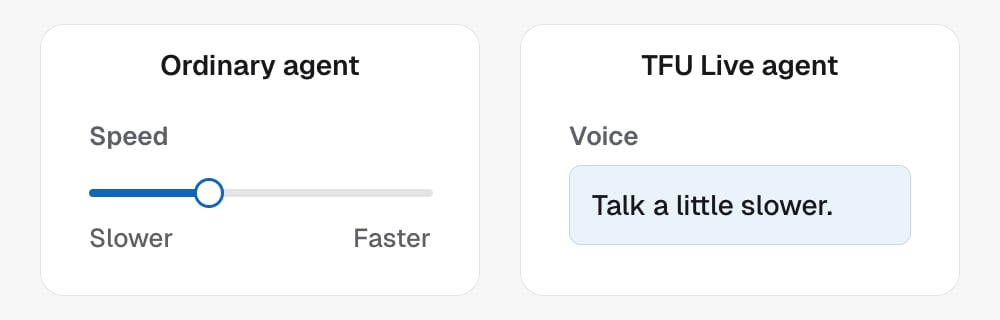
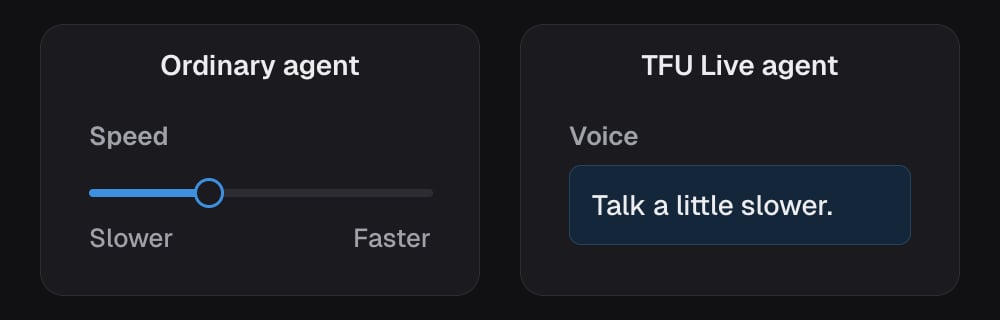 That sounds like less control. It is more, because a sentence can say things a
slider cannot. "Let them finish, even when you already know the answer" is a
real instruction here.
## You talk to it, and it changes itself
The builder opens on one thing: talk to the agent. Tell it what to change and
it changes itself, then tells you what it did. There is no prompt on the screen
until you open **Configure myself**. Its **Settings** tab holds the shared
campaign controls, including caller numbers and calling hours.
Underneath, an agent is two pieces of writing:
| | What it holds |
| - | - |
| **Brain** | Who it is, what it knows, how the conversation should go, and what it can do. Used on calls and on texts. See [the brain](/agents/tfu-live-brain) and [capabilities and workflows](/agents/tfu-live-capabilities). |
| **Voice** | Which voice it speaks in, and how it handles a live line: accent, pace, interruptions, silences. Calls only. See [the voice](/agents/tfu-live-voice). |
**Configure myself** opens **Brain**, **Power Dialer** and **Settings** for when
you would rather edit than ask. Brain switches between **Workflows**,
**Instructions** (the brain's writing) and **Voice**. **Build with AI** shows the changes
the assistant saves in the left column.
The campaign trigger is drawn above the agent on the brain's canvas, because
starting a conversation is what feeds the brain. It is an ordinary campaign:
name, the tags that start a call, stop tags, caller number and calling hours.
Whether the agent may text is **Chat**, on Brain's **Channels** card. The trigger editor exposes the supported ways to start a conversation.
Follow up attempts after the first call live in **Power Dialer**, the same
panel every other campaign uses. See [Power Dialer](/campaigns/power-dialer).
## The same character on every channel
The agent that takes the call is also the agent that answers the text
afterwards. Both read the same brain, so a lead who rings on Tuesday and texts
on Thursday is talking to one person with one set of facts.
It answers texts only while **Chat** is on. A text that arrives during a call
goes into that call instead of getting a text back.
Only the voice is channel specific, because pauses and interruptions do not
exist on a screen.
## Controls that do not exist here
| You want | On a TFU Live agent |
| - | - |
| Slower, warmer, less robotic, less pushy | Write it. Manner is the brain, delivery is the voice. There is no speed or expressiveness setting. |
| Let the caller interrupt, or stop it talking over people | The voice. |
| A different language or accent | The voice. Language is written; the accent comes with the voice you pick. |
| Background sound or noise handling | Supported background presets and volume are available in Voice. Other delivery behaviour is written in the voice instructions. |
| A separate FAQ, steps list or knowledge base | The brain holds all of it. |
| A split test | Not available on this runtime yet. |
| An inbound, outbound or confirmation type | There is no type. What starts the call is the campaign trigger. |
## Saving, versions and going live
Saving does not change the call happening right now. Each save is set up as the
next authored version. An explicit draft remains unprovisioned until requested
preparation or roleplay. Calls keep using the current version until the new one is
verified. A change to the speaking voice or the voice writing alone has nothing
to set up, so the next call uses it straight away.
The header tells you where it is: **Draft**, **Setting up…** (or **Setting up
the new version…**), **Ready**, or **Setup blocked** or **Setup needs review**
when the last attempt needs a person.
A blocked setup, or one that needs review, says so wherever you are and needs a
look from Team Follow Up before the agent will take the change.
**Saved changes**, on the left of Build with AI, is the record of every save:
who made it (you, or the agent changing itself in the conversation), when, and
exactly what moved. Each entry names the change in words and opens to show it:
the lines added to and taken out of the Brain and the voice instructions, the
old and new speaking voice, the capabilities equipped or removed, the settings
that changed. Nothing here is the agent's own account of what it did; it is
what the save actually changed.
**Restore** on an earlier entry brings that version's text back as a new save,
which sets up like any other. Nothing is rewritten: the history keeps growing,
and the new entry says which revision it restored. The last fifty saves of an
agent can be restored.
A browser test refuses to start while a save is still setting up, and says so.
Testing in that window would have you listening to the old version and
concluding your change did nothing.
**Go live** and **Pause** behave like any other campaign, and the **Before
going live** list names anything missing.
## Testing it
* **Roleplay.** In the browser, spoken or typed. You play the lead and the
agent plays itself, on its real script. Nothing real happens: no tags, no
texts, no bookings, no call. Correct it as it goes and it changes itself.
* **Test column.** On the left of **Configure myself**, the same column every
agent has: a browser call to the agent as it is saved, with nobody taking
corrections while it runs. When it ends, say what was wrong and the agent
takes it as a change. Actions are simulated.
* **Real test call.** An actual call, straight to the agent.
* **Real test call on the campaign.** The whole thing end to end, to a real
contact in your CRM.
More in [Test your agent](/agents/test-your-agent).
## Who can change it
Agency owners (`agency_admin`) and Team Follow Up staff can create and edit
TFU Live agents. Owners use **Build with AI** or **Configure myself** within
their own sub-accounts, including voice roleplay and the normal test flows.
Project users cannot create agents. New agents receive a paused campaign;
going live still requires valid caller numbers, triggers and ready calling resources.
API integrations use the scoped public aggregate with `agents:write`; browser
access does not grant provider administration or cross-agency access.
## In the API
This local integration exposes [Create and update TFU Live agent](/api-reference/tfu-live)
with the complete Brain and Voice. It is not a production publication. See
[Build a TFU Live agent](/tfu-live/authoring) for scope and revision requirements.
The calls they place are
ordinary calls: they appear in [call history](/concepts/call-history) and come
back from [List calls](/api-reference/calls/list-calls) with the same fields as
any other call, and the campaign behind one is updated with
[Update campaign](/api-reference/campaigns/update-campaign).
## Related
* [The brain](/agents/tfu-live-brain)
* [The voice](/agents/tfu-live-voice)
* [Capabilities and workflows](/agents/tfu-live-capabilities)
* [What an agent is](/agents/overview)
## Author through the API
Create or update the whole Brain and Voice through the dedicated [TFU Live API](/api-reference/tfu-live). Follow [Build a TFU Live agent](/tfu-live/authoring) for the saved-revision contract.
New TFU Live agents automatically receive a paused campaign and a private Power Dialer cadence. Choose **From numbers** and calling hours in **Settings**, and configure enrollment in the **Brain** trigger. Creating an agent does not start calls.
That sounds like less control. It is more, because a sentence can say things a
slider cannot. "Let them finish, even when you already know the answer" is a
real instruction here.
## You talk to it, and it changes itself
The builder opens on one thing: talk to the agent. Tell it what to change and
it changes itself, then tells you what it did. There is no prompt on the screen
until you open **Configure myself**. Its **Settings** tab holds the shared
campaign controls, including caller numbers and calling hours.
Underneath, an agent is two pieces of writing:
| | What it holds |
| - | - |
| **Brain** | Who it is, what it knows, how the conversation should go, and what it can do. Used on calls and on texts. See [the brain](/agents/tfu-live-brain) and [capabilities and workflows](/agents/tfu-live-capabilities). |
| **Voice** | Which voice it speaks in, and how it handles a live line: accent, pace, interruptions, silences. Calls only. See [the voice](/agents/tfu-live-voice). |
**Configure myself** opens **Brain**, **Power Dialer** and **Settings** for when
you would rather edit than ask. Brain switches between **Workflows**,
**Instructions** (the brain's writing) and **Voice**. **Build with AI** shows the changes
the assistant saves in the left column.
The campaign trigger is drawn above the agent on the brain's canvas, because
starting a conversation is what feeds the brain. It is an ordinary campaign:
name, the tags that start a call, stop tags, caller number and calling hours.
Whether the agent may text is **Chat**, on Brain's **Channels** card. The trigger editor exposes the supported ways to start a conversation.
Follow up attempts after the first call live in **Power Dialer**, the same
panel every other campaign uses. See [Power Dialer](/campaigns/power-dialer).
## The same character on every channel
The agent that takes the call is also the agent that answers the text
afterwards. Both read the same brain, so a lead who rings on Tuesday and texts
on Thursday is talking to one person with one set of facts.
It answers texts only while **Chat** is on. A text that arrives during a call
goes into that call instead of getting a text back.
Only the voice is channel specific, because pauses and interruptions do not
exist on a screen.
## Controls that do not exist here
| You want | On a TFU Live agent |
| - | - |
| Slower, warmer, less robotic, less pushy | Write it. Manner is the brain, delivery is the voice. There is no speed or expressiveness setting. |
| Let the caller interrupt, or stop it talking over people | The voice. |
| A different language or accent | The voice. Language is written; the accent comes with the voice you pick. |
| Background sound or noise handling | Supported background presets and volume are available in Voice. Other delivery behaviour is written in the voice instructions. |
| A separate FAQ, steps list or knowledge base | The brain holds all of it. |
| A split test | Not available on this runtime yet. |
| An inbound, outbound or confirmation type | There is no type. What starts the call is the campaign trigger. |
## Saving, versions and going live
Saving does not change the call happening right now. Each save is set up as the
next authored version. An explicit draft remains unprovisioned until requested
preparation or roleplay. Calls keep using the current version until the new one is
verified. A change to the speaking voice or the voice writing alone has nothing
to set up, so the next call uses it straight away.
The header tells you where it is: **Draft**, **Setting up…** (or **Setting up
the new version…**), **Ready**, or **Setup blocked** or **Setup needs review**
when the last attempt needs a person.
A blocked setup, or one that needs review, says so wherever you are and needs a
look from Team Follow Up before the agent will take the change.
**Saved changes**, on the left of Build with AI, is the record of every save:
who made it (you, or the agent changing itself in the conversation), when, and
exactly what moved. Each entry names the change in words and opens to show it:
the lines added to and taken out of the Brain and the voice instructions, the
old and new speaking voice, the capabilities equipped or removed, the settings
that changed. Nothing here is the agent's own account of what it did; it is
what the save actually changed.
**Restore** on an earlier entry brings that version's text back as a new save,
which sets up like any other. Nothing is rewritten: the history keeps growing,
and the new entry says which revision it restored. The last fifty saves of an
agent can be restored.
A browser test refuses to start while a save is still setting up, and says so.
Testing in that window would have you listening to the old version and
concluding your change did nothing.
**Go live** and **Pause** behave like any other campaign, and the **Before
going live** list names anything missing.
## Testing it
* **Roleplay.** In the browser, spoken or typed. You play the lead and the
agent plays itself, on its real script. Nothing real happens: no tags, no
texts, no bookings, no call. Correct it as it goes and it changes itself.
* **Test column.** On the left of **Configure myself**, the same column every
agent has: a browser call to the agent as it is saved, with nobody taking
corrections while it runs. When it ends, say what was wrong and the agent
takes it as a change. Actions are simulated.
* **Real test call.** An actual call, straight to the agent.
* **Real test call on the campaign.** The whole thing end to end, to a real
contact in your CRM.
More in [Test your agent](/agents/test-your-agent).
## Who can change it
Agency owners (`agency_admin`) and Team Follow Up staff can create and edit
TFU Live agents. Owners use **Build with AI** or **Configure myself** within
their own sub-accounts, including voice roleplay and the normal test flows.
Project users cannot create agents. New agents receive a paused campaign;
going live still requires valid caller numbers, triggers and ready calling resources.
API integrations use the scoped public aggregate with `agents:write`; browser
access does not grant provider administration or cross-agency access.
## In the API
This local integration exposes [Create and update TFU Live agent](/api-reference/tfu-live)
with the complete Brain and Voice. It is not a production publication. See
[Build a TFU Live agent](/tfu-live/authoring) for scope and revision requirements.
The calls they place are
ordinary calls: they appear in [call history](/concepts/call-history) and come
back from [List calls](/api-reference/calls/list-calls) with the same fields as
any other call, and the campaign behind one is updated with
[Update campaign](/api-reference/campaigns/update-campaign).
## Related
* [The brain](/agents/tfu-live-brain)
* [The voice](/agents/tfu-live-voice)
* [Capabilities and workflows](/agents/tfu-live-capabilities)
* [What an agent is](/agents/overview)
## Author through the API
Create or update the whole Brain and Voice through the dedicated [TFU Live API](/api-reference/tfu-live). Follow [Build a TFU Live agent](/tfu-live/authoring) for the saved-revision contract.
New TFU Live agents automatically receive a paused campaign and a private Power Dialer cadence. Choose **From numbers** and calling hours in **Settings**, and configure enrollment in the **Brain** trigger. Creating an agent does not start calls.