> ## Documentation Index
> Fetch the complete documentation index at: https://docs.teamfollowup.ai/llms.txt
> Use this file to discover all available pages before exploring further.
> ## Agent Instructions
> Use the public API base URL: https://api.teamfollowup.ai/api.
> Authenticate public API requests with Authorization: Bearer YOUR_API_KEY.
> Use product-owned terms: agents, campaigns, projects (GoHighLevel sub-accounts), contacts, calls, outcomes, skills, cadences, phone numbers.
> Scope requests by locationId rather than projectName.
> Read the guide linked from each API reference group before recommending an endpoint.
# The voice
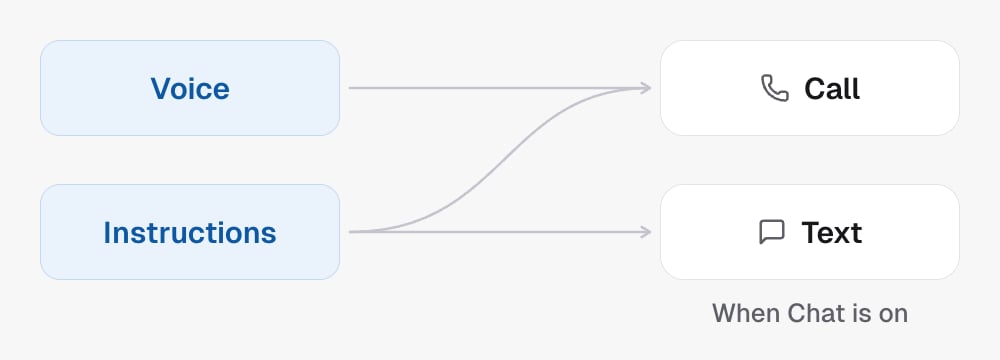
> The one thing you pick rather than write, the room behind it, and the short piece of writing that only matters while someone is listening.
The **voice** of a [TFU Live agent](/agents/tfu-live) is the only part that
stops mattering the moment the conversation moves to text: which voice it
speaks in, the room heard behind it, and how it handles a live line. Open
**Configure myself**, then **Voice** in Brain's switch: the voice and the
**Background** button sit above the writing, and the writing takes the screen. Caller numbers,
calling hours and other shared campaign controls live in **Settings**.
Everything else about the agent lives in [the brain](/agents/tfu-live-brain),
because it is just as true in a message as it is out loud.
 ## Picking the voice
This is the one hard choice on the whole agent. The voice sets the things you
cannot talk it out of: its basic timbre, its range, how old it sounds. You
cannot write your way from one voice to another, so if a client has a strong
preference, start here rather than in the writing.
There are 22 voices. The button above the writing names the one in use; click it
to open the picker. Each row gives the provider's own description of the voice,
the accent it carries and whether it reads as a woman or a man, and you can
narrow the list by gender and accent before you listen. Picking a row saves it.
Besides North American voices there are Southern U.S. (Delta, Cinder), British
(Vesper), Irish (Willow, Stone), Australian (Quartz, Ripple) and Filipino
(Beacon) voices, and two made for Brazilian Portuguese (Bossa, Tempo). Every
voice can speak other languages; test it with the language your calls use.
Listen to the sample before you choose. **Marin** is the voice every new agent
starts with.
| Voice | Sounds like | Accent | Reads as | Source |
| - | - | - | - | - |
| **Alloy** | Balanced and clear | North American | Man | Generated |
| **Ash** | Savvy and relaxed | North American | Man | Generated |
| **Ballad** | Cheerful and candid | North American | Man | Generated |
| **Beacon** | Clear and personable | Filipino | Man | Generated |
| **Bossa** | Clear and direct, made for Portuguese | Brazilian | Woman | Natural |
| **Cedar** | Open and upbeat | North American | Man | Natural |
| **Cinder** | Steady and grounded | Southern U.S. | Man | Generated |
| **Coral** | Easygoing and versatile | North American | Woman | Generated |
| **Delta** | Warm and easygoing | Southern U.S. | Woman | Generated |
| **Echo** | Bright and inquisitive | North American | Man | Generated |
| **Gleam** | Warm and conversational | North American | Woman | Natural |
| **Marin** | Animated and earnest | North American | Woman | Natural |
| **Meridian** | Grounded and measured | North American | Man | Natural |
| **Quartz** | Warm and conversational | Australian | Woman | Generated |
| **Ripple** | Warm and conversational | Australian | Man | Natural |
| **Sage** | Confident and optimistic | North American | Woman | Generated |
| **Shimmer** | Composed and direct | North American | Woman | Generated |
| **Stone** | Calm and precise | Irish | Man | Natural |
| **Tempo** | Grounded and measured, made for Portuguese | Brazilian | Man | Natural |
| **Verse** | Calm and affirming | North American | Man | Generated |
| **Vesper** | Clear and direct | British | Man | Natural |
| **Willow** | Expressive and bright | Irish | Woman | Natural |
Every description, accent, gender and source (natural or generated) above is
the provider's own tag for the voice. Your ears decide: the tags only tell you
where to start.
## Hearing it
Samples tell you about the voice and nothing about the conversation. The
**Test** column on the left of **Configure myself**, the same one every agent
has, places a browser call to the agent as it is saved: its real script, its
real voice, the room behind it. Actions are simulated, so no tags, texts or
bookings land. When the call ends, say what was wrong there and the agent
takes it as a change.
It will not start while a save is still setting up, and says so, because you
would be listening to the old version and concluding your change did nothing.
This is different from **Roleplay** in **Build with AI**, where you play the
lead and can correct the agent out loud as it goes. Here nobody is taking
notes: it is a call, and the way out is ending it.
## What you write here
A short piece, usually five or six lines, covering only what needs audio to
exist:
* **Accent.** The accent comes with the voice: pick a voice that already has
the one you want. Writing a different accent here does not change it.
* **Language.** Ask it to speak Spanish and it speaks Spanish.
* **Pace and energy.** Brisk, relaxed, low key. There is no speed setting on
this runtime: the pace is what you write here.
* **Interruptions.** What it does when someone talks over it. Stopping at once
and answering what was actually said is usually right.
* **Silence.** Whether it fills a pause or lets it sit.
* **Listening.** The small sounds a person makes while someone runs on.
* **Imperfection.** Whether a natural stumble is fine, and where it never is:
a name, a time, a price, a confirmation.
Every new agent starts with a standard delivery already written: a natural,
brisk pace that slows only for names, times, prices and confirmations, stops
the moment someone cuts in, a small listening sound while they talk.
Change what does not suit the business.
The **Variable** button above the writing drops in `{{first_name}}` and the
other contact fields, custom fields and custom values, the same list an
ordinary agent's prompt offers. They are filled from the CRM contact on every
call and every text. A field the contact does not have comes out blank, never
as braces.
## Background sound
By default the line is silent. The **Background** button above the writing puts a room
behind the agent, mixed under its voice on every call: **Office**, or **People
nearby**. Volume runs
from 0 to 100; around 40 is a room someone notices only if they listen for it,
and the **Listen** button plays it without a call.
Unlike the voice, the room does not wait for the next call. Move the slider
during a browser call and you hear it change under the voice you are listening
to. It is easy to overdo: if it is distracting on a quiet listen, it is worse
on a phone speaker in a supermarket. When in doubt, leave it off.
## Written, not dialled
Worth being straight about the trade. On an ordinary agent, speaking speed is a
number, and the same number produces the same result on the thousandth call.
Here it is a sentence, and a sentence persuades rather than guarantees.
Ask for slower and you get slower on most calls, a little less so late in a long
one, and slightly differently tomorrow. In exchange you can ask for things no
slider ever offered, like "let them finish even when you already know the
answer", so the trade is usually worth taking.
Two things follow from it. Pick the voice closest to what you want before you
start writing: its accent is its own, and no sentence here changes it. And keep
anything that must be exact, a price, a time, a spelling, in
[the brain](/agents/tfu-live-brain) rather than trusting it to delivery.
There is no speaking speed, expressiveness or noise handling setting here.
Those are sentences on this runtime, written in the delivery text above.
## The orb colour
The orb is the round shape that stands for the agent on your screens. Its
colours are cosmetic: they change how the agent looks to you and your
team, never what it says, how it sounds or what it does on a call. The `style`
field names one of four kinds.
| Kind | `style` | What you see |
| - | - | - |
| Follows the voice | `default` | Purple and pink when the voice reads as a woman, blue and cyan when it reads as a man, indigo and mint when it reads as neither. It changes with the voice. Every agent starts here. |
| Curated | `curated` | A pair worked out from the agent's id, the same on every screen whatever the voice. |
| Preset | `preset` | One of 17 pairs from published palettes, named in the `preset` field. |
| Custom | `custom` | Two colours you choose, written as `#rrggbb` in the `colors` field. The first is the orb's own colour, the second its glow. |
Every preset is a pair: a main colour for the orb and a glow colour around it.
Each pair comes from a published palette: Figma's
[100 Color Combinations](https://www.figma.com/resource-library/color-combinations/),
Figma's [color palette library](https://www.figma.com/color-palettes/) or the
presets of [Paper Shaders](https://github.com/paper-design/shaders).
The main colour is the palette's first real colour and the glow the next of its
colours that differs from it, exactly as the palette gives them; the Source
column says which of the palette's colours they are.
| Preset | `preset` | Main colour | Glow colour | Source |
| - | - | - | - | - |
| **Watermelon** | `watermelon` | Pink `#FC6C85` | Lime `#89F336` | Figma, Watermelon splash (1st and 2nd) |
| **Harvest** | `harvest` | Burgundy `#800020` | Gold `#FFCE1B` | Figma, Harvest moon (1st and 2nd) |
| **Lo-Fi** | `lofi` | Red `#D72638` | Blue `#3F88C5` | Paper Shaders, Static Radial Gradient preset "Lo-Fi" (1st and 2nd) |
| **Guava** | `guava` | Coral `#FF8559` | Raspberry `#CF5376` | Figma, Guava (1st and 4th) |
| **Tropical** | `tropical` | Mango `#FF8243` | Pink `#FFC0CB` | Figma, Tropical punch (1st and 2nd) |
| **Truffle** | `truffle` | Chocolate `#713600` | Cream `#FDFBD4` | Figma, Chocolate truffle (1st and 3rd) |
| **Horizon** | `horizon` | Amber `#FFB343` | Cyan `#42EAFF` | Figma, Glowing horizon (1st and 2nd) |
| **Lotus** | `lotus` | Mint `#ADEBB3` | Coral `#FF857A` | Figma, Lotus garden (1st and 2nd) |
| **Retro** | `retro` | Tiffany blue `#81D8D0` | Tan `#D99E82` | Figma, Retro calm (1st and 2nd) |
| **Tide** | `tide` | Cyan `#00D1D1` | Blue `#4052D6` | Figma, Ocean tide (1st and 2nd) |
| **Pop** | `pop` | Cyan `#00F0FF` | Hot pink `#FF46A2` | Figma, Pop art (1st and 2nd) |
| **Yacht** | `yacht` | Petrol `#245F73` | Brown `#733E24` | Figma, Yacht club (3rd and 4th) |
| **Cobalt** | `cobalt` | Cobalt `#0047AB` | Sky `#82C8E5` | Figma, Cobalt sky (1st and 3rd) |
| **Northern lights** | `northern` | Indigo `#4C4794` | Plum `#774A7D` | Paper Shaders, Pulsing Border preset "Northern lights" (1st and 2nd) |
| **Amethyst** | `amethyst` | Violet `#8A00C4` | Magenta `#C4009C` | Figma color palette library, [Majestic Amethyst](https://www.figma.com/color-palettes/majestic-amethyst/) (1st and 2nd) |
| **Orchard** | `orchard` | Plum `#8E4585` | Goldenrod `#DAA520` | Figma, Autumn orchard (1st and 2nd) |
| **Berries** | `berries` | Pink `#FD3DB5` | Orange `#FB6A2C` | Figma, Space berries (1st and 3rd) |
Changing the colour saves no new version of the agent and adds nothing to its
change history, so there is nothing to review and nothing to set up again. You
can change it while the agent is live.
## In the API
| On this page | Field |
| - | - |
| The voice | `voice.voiceId` |
| What you write here | `voice.prompt` |
| Background sound | `voice.background`, with `enabled`, `preset` for the room and `volume` from 0 to 100 |
| The orb colour | `orb` |
[Get TFU Live agent](/api-reference/tfu-live/get-tfu-live-agent) returns all
of them, and `orb` is `{"style": "default"}` for an agent that never chose.
[Update TFU Live agent](/api-reference/tfu-live/update-tfu-live-agent) saves
the voice with the rest of the agent.
[Set TFU Live agent orb colour](/api-reference/tfu-live/set-tfu-live-agent-orb-colour)
changes the orb on its own, with no `ifVersion`; anything but one of the four
shapes is refused with `invalid_agent`. See the [Agent glossary](/glossary#agents).
## Related
* [TFU Live agents](/agents/tfu-live)
* [The brain](/agents/tfu-live-brain)
* [How your agent sounds](/agents/voice), the equivalent for an ordinary agent,
where these are settings instead of sentences.
## Picking the voice
This is the one hard choice on the whole agent. The voice sets the things you
cannot talk it out of: its basic timbre, its range, how old it sounds. You
cannot write your way from one voice to another, so if a client has a strong
preference, start here rather than in the writing.
There are 22 voices. The button above the writing names the one in use; click it
to open the picker. Each row gives the provider's own description of the voice,
the accent it carries and whether it reads as a woman or a man, and you can
narrow the list by gender and accent before you listen. Picking a row saves it.
Besides North American voices there are Southern U.S. (Delta, Cinder), British
(Vesper), Irish (Willow, Stone), Australian (Quartz, Ripple) and Filipino
(Beacon) voices, and two made for Brazilian Portuguese (Bossa, Tempo). Every
voice can speak other languages; test it with the language your calls use.
Listen to the sample before you choose. **Marin** is the voice every new agent
starts with.
| Voice | Sounds like | Accent | Reads as | Source |
| - | - | - | - | - |
| **Alloy** | Balanced and clear | North American | Man | Generated |
| **Ash** | Savvy and relaxed | North American | Man | Generated |
| **Ballad** | Cheerful and candid | North American | Man | Generated |
| **Beacon** | Clear and personable | Filipino | Man | Generated |
| **Bossa** | Clear and direct, made for Portuguese | Brazilian | Woman | Natural |
| **Cedar** | Open and upbeat | North American | Man | Natural |
| **Cinder** | Steady and grounded | Southern U.S. | Man | Generated |
| **Coral** | Easygoing and versatile | North American | Woman | Generated |
| **Delta** | Warm and easygoing | Southern U.S. | Woman | Generated |
| **Echo** | Bright and inquisitive | North American | Man | Generated |
| **Gleam** | Warm and conversational | North American | Woman | Natural |
| **Marin** | Animated and earnest | North American | Woman | Natural |
| **Meridian** | Grounded and measured | North American | Man | Natural |
| **Quartz** | Warm and conversational | Australian | Woman | Generated |
| **Ripple** | Warm and conversational | Australian | Man | Natural |
| **Sage** | Confident and optimistic | North American | Woman | Generated |
| **Shimmer** | Composed and direct | North American | Woman | Generated |
| **Stone** | Calm and precise | Irish | Man | Natural |
| **Tempo** | Grounded and measured, made for Portuguese | Brazilian | Man | Natural |
| **Verse** | Calm and affirming | North American | Man | Generated |
| **Vesper** | Clear and direct | British | Man | Natural |
| **Willow** | Expressive and bright | Irish | Woman | Natural |
Every description, accent, gender and source (natural or generated) above is
the provider's own tag for the voice. Your ears decide: the tags only tell you
where to start.
## Hearing it
Samples tell you about the voice and nothing about the conversation. The
**Test** column on the left of **Configure myself**, the same one every agent
has, places a browser call to the agent as it is saved: its real script, its
real voice, the room behind it. Actions are simulated, so no tags, texts or
bookings land. When the call ends, say what was wrong there and the agent
takes it as a change.
It will not start while a save is still setting up, and says so, because you
would be listening to the old version and concluding your change did nothing.
This is different from **Roleplay** in **Build with AI**, where you play the
lead and can correct the agent out loud as it goes. Here nobody is taking
notes: it is a call, and the way out is ending it.
## What you write here
A short piece, usually five or six lines, covering only what needs audio to
exist:
* **Accent.** The accent comes with the voice: pick a voice that already has
the one you want. Writing a different accent here does not change it.
* **Language.** Ask it to speak Spanish and it speaks Spanish.
* **Pace and energy.** Brisk, relaxed, low key. There is no speed setting on
this runtime: the pace is what you write here.
* **Interruptions.** What it does when someone talks over it. Stopping at once
and answering what was actually said is usually right.
* **Silence.** Whether it fills a pause or lets it sit.
* **Listening.** The small sounds a person makes while someone runs on.
* **Imperfection.** Whether a natural stumble is fine, and where it never is:
a name, a time, a price, a confirmation.
Every new agent starts with a standard delivery already written: a natural,
brisk pace that slows only for names, times, prices and confirmations, stops
the moment someone cuts in, a small listening sound while they talk.
Change what does not suit the business.
The **Variable** button above the writing drops in `{{first_name}}` and the
other contact fields, custom fields and custom values, the same list an
ordinary agent's prompt offers. They are filled from the CRM contact on every
call and every text. A field the contact does not have comes out blank, never
as braces.
## Background sound
By default the line is silent. The **Background** button above the writing puts a room
behind the agent, mixed under its voice on every call: **Office**, or **People
nearby**. Volume runs
from 0 to 100; around 40 is a room someone notices only if they listen for it,
and the **Listen** button plays it without a call.
Unlike the voice, the room does not wait for the next call. Move the slider
during a browser call and you hear it change under the voice you are listening
to. It is easy to overdo: if it is distracting on a quiet listen, it is worse
on a phone speaker in a supermarket. When in doubt, leave it off.
## Written, not dialled
Worth being straight about the trade. On an ordinary agent, speaking speed is a
number, and the same number produces the same result on the thousandth call.
Here it is a sentence, and a sentence persuades rather than guarantees.
Ask for slower and you get slower on most calls, a little less so late in a long
one, and slightly differently tomorrow. In exchange you can ask for things no
slider ever offered, like "let them finish even when you already know the
answer", so the trade is usually worth taking.
Two things follow from it. Pick the voice closest to what you want before you
start writing: its accent is its own, and no sentence here changes it. And keep
anything that must be exact, a price, a time, a spelling, in
[the brain](/agents/tfu-live-brain) rather than trusting it to delivery.
There is no speaking speed, expressiveness or noise handling setting here.
Those are sentences on this runtime, written in the delivery text above.
## The orb colour
The orb is the round shape that stands for the agent on your screens. Its
colours are cosmetic: they change how the agent looks to you and your
team, never what it says, how it sounds or what it does on a call. The `style`
field names one of four kinds.
| Kind | `style` | What you see |
| - | - | - |
| Follows the voice | `default` | Purple and pink when the voice reads as a woman, blue and cyan when it reads as a man, indigo and mint when it reads as neither. It changes with the voice. Every agent starts here. |
| Curated | `curated` | A pair worked out from the agent's id, the same on every screen whatever the voice. |
| Preset | `preset` | One of 17 pairs from published palettes, named in the `preset` field. |
| Custom | `custom` | Two colours you choose, written as `#rrggbb` in the `colors` field. The first is the orb's own colour, the second its glow. |
Every preset is a pair: a main colour for the orb and a glow colour around it.
Each pair comes from a published palette: Figma's
[100 Color Combinations](https://www.figma.com/resource-library/color-combinations/),
Figma's [color palette library](https://www.figma.com/color-palettes/) or the
presets of [Paper Shaders](https://github.com/paper-design/shaders).
The main colour is the palette's first real colour and the glow the next of its
colours that differs from it, exactly as the palette gives them; the Source
column says which of the palette's colours they are.
| Preset | `preset` | Main colour | Glow colour | Source |
| - | - | - | - | - |
| **Watermelon** | `watermelon` | Pink `#FC6C85` | Lime `#89F336` | Figma, Watermelon splash (1st and 2nd) |
| **Harvest** | `harvest` | Burgundy `#800020` | Gold `#FFCE1B` | Figma, Harvest moon (1st and 2nd) |
| **Lo-Fi** | `lofi` | Red `#D72638` | Blue `#3F88C5` | Paper Shaders, Static Radial Gradient preset "Lo-Fi" (1st and 2nd) |
| **Guava** | `guava` | Coral `#FF8559` | Raspberry `#CF5376` | Figma, Guava (1st and 4th) |
| **Tropical** | `tropical` | Mango `#FF8243` | Pink `#FFC0CB` | Figma, Tropical punch (1st and 2nd) |
| **Truffle** | `truffle` | Chocolate `#713600` | Cream `#FDFBD4` | Figma, Chocolate truffle (1st and 3rd) |
| **Horizon** | `horizon` | Amber `#FFB343` | Cyan `#42EAFF` | Figma, Glowing horizon (1st and 2nd) |
| **Lotus** | `lotus` | Mint `#ADEBB3` | Coral `#FF857A` | Figma, Lotus garden (1st and 2nd) |
| **Retro** | `retro` | Tiffany blue `#81D8D0` | Tan `#D99E82` | Figma, Retro calm (1st and 2nd) |
| **Tide** | `tide` | Cyan `#00D1D1` | Blue `#4052D6` | Figma, Ocean tide (1st and 2nd) |
| **Pop** | `pop` | Cyan `#00F0FF` | Hot pink `#FF46A2` | Figma, Pop art (1st and 2nd) |
| **Yacht** | `yacht` | Petrol `#245F73` | Brown `#733E24` | Figma, Yacht club (3rd and 4th) |
| **Cobalt** | `cobalt` | Cobalt `#0047AB` | Sky `#82C8E5` | Figma, Cobalt sky (1st and 3rd) |
| **Northern lights** | `northern` | Indigo `#4C4794` | Plum `#774A7D` | Paper Shaders, Pulsing Border preset "Northern lights" (1st and 2nd) |
| **Amethyst** | `amethyst` | Violet `#8A00C4` | Magenta `#C4009C` | Figma color palette library, [Majestic Amethyst](https://www.figma.com/color-palettes/majestic-amethyst/) (1st and 2nd) |
| **Orchard** | `orchard` | Plum `#8E4585` | Goldenrod `#DAA520` | Figma, Autumn orchard (1st and 2nd) |
| **Berries** | `berries` | Pink `#FD3DB5` | Orange `#FB6A2C` | Figma, Space berries (1st and 3rd) |
Changing the colour saves no new version of the agent and adds nothing to its
change history, so there is nothing to review and nothing to set up again. You
can change it while the agent is live.
## In the API
| On this page | Field |
| - | - |
| The voice | `voice.voiceId` |
| What you write here | `voice.prompt` |
| Background sound | `voice.background`, with `enabled`, `preset` for the room and `volume` from 0 to 100 |
| The orb colour | `orb` |
[Get TFU Live agent](/api-reference/tfu-live/get-tfu-live-agent) returns all
of them, and `orb` is `{"style": "default"}` for an agent that never chose.
[Update TFU Live agent](/api-reference/tfu-live/update-tfu-live-agent) saves
the voice with the rest of the agent.
[Set TFU Live agent orb colour](/api-reference/tfu-live/set-tfu-live-agent-orb-colour)
changes the orb on its own, with no `ifVersion`; anything but one of the four
shapes is refused with `invalid_agent`. See the [Agent glossary](/glossary#agents).
## Related
* [TFU Live agents](/agents/tfu-live)
* [The brain](/agents/tfu-live-brain)
* [How your agent sounds](/agents/voice), the equivalent for an ordinary agent,
where these are settings instead of sentences.